
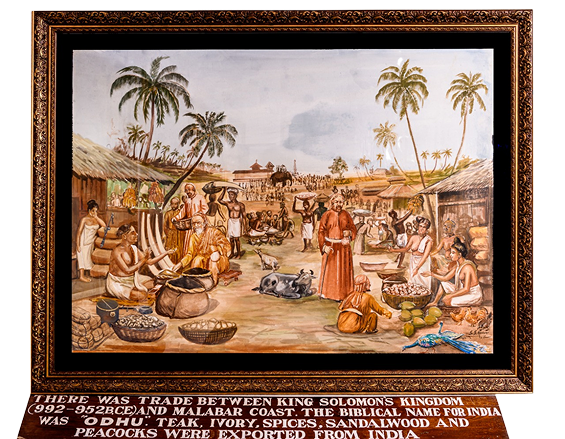
The story of the Jewish community in Kochi is one steeped in antiquity. It is widely believed that Jews first set foot in Malabar in 379 AD, but evidence from Jewish history suggests even earlier connections, with King Solomon dispatching ships around 1000 BC to acquire exotic treasures like ivory, peacocks, and monkeys from this lush land.

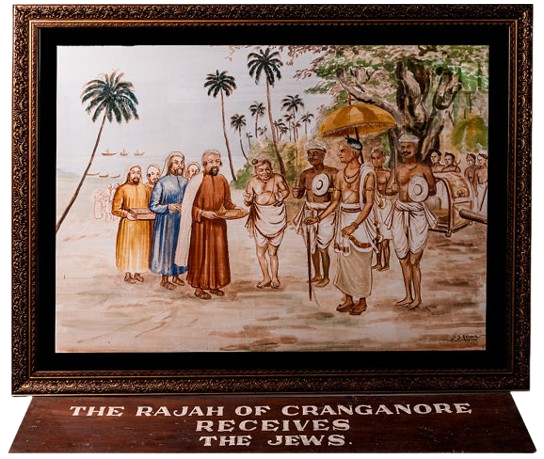
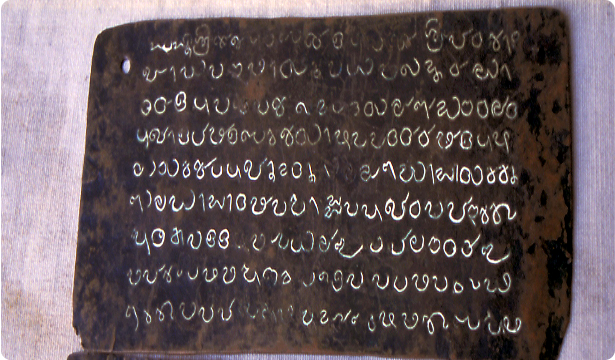
Their initial settlement was in Cranganore, referred to as Shingly in Hebrew and Muzris in Greek, where they were welcomed with open arms. In 1000 CE, the benevolent Kerala ruler, Baskara Ravivarma, honored Joseph Rabban, the first elected Jewish leader, with privileges meticulously inscribed on a set of three copper plates in the ancient script of vatta ezhuth (an archaic form of Malayalam).
However, the arrival of the Moors in 1300 AD led to the Jews' displacement from Cranganore to Kochi, Parur, Mala, Chendamangalam, Eranakulam, and beyond.
With the arrival of the Portuguese in 1506 AD the remaining Jewish families of Cranganore left for Kochi. In 1568, four resolute families secured land from the Raja of Travancore, near his palace (known today as the Dutch Palace), and erected the iconic Paradesi Synagogue.

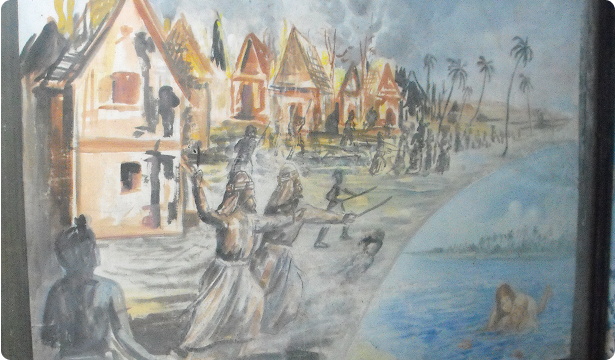
Tragedy struck in 1662 AD when Portuguese forces attacked and set the Synagogue ablaze, causing loss of life and irreplaceable scriptures and books. However, the community painstakingly restored the Synagogue in 1663 – a testament to their enduring resilience.

In a historic decree dated circa 1000 CE, Kerala's ruler, Cheruman Perumal, granted Joseph Rabban a remarkable privilege, meticulously inscribed in the ancient script of VattaEzhuthu (archaic). Joseph Rabban, a distinguished figure, became the inaugural elected leader of the Jewish community. This momentous event marked the establishment of the renowned Jewish community of Anjuvannam in the heart of Kerala.
Today, visitors to the Paradesi Synagogue have the unique opportunity to explore a facsimile of these significant copper plates, alongside their translated versions, available for purchase. These remarkable artifacts offer a tangible link to the rich history and heritage of the Jewish community in Kochi.
In 1968, the community celebrated the 400th anniversary of the synagogue, with weeklong festivities from Dec. 15 to 19.
The then Indian Prime Minister Indira Gandhi inaugurated the festivities, attended also by historical scholars, art experts, archaeologists and tourists. The Indian Government also issued a postage stamp and first day cover to mark the 400th anniversary.


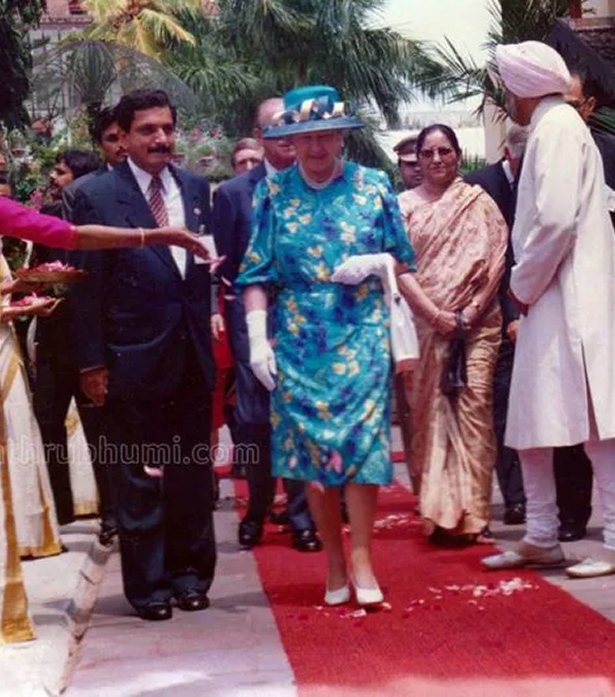
The Paradesi Synagogue has welcomed a host of distinguished visitors, among them the late Queen Elizabeth II, Charles, King of England, President of Israel Ezer Weitzman, and a long list of illustrious names.
Queen Elizabeth II, in particular, held a special fascination for the Paradesi Synagogue, personally requesting a visit as part of her Indian tour in October 1997. Her curiosity was piqued by her sister, the late Princess Margaret, who had previously marveled at the Synagogue's beauty during her own visit.
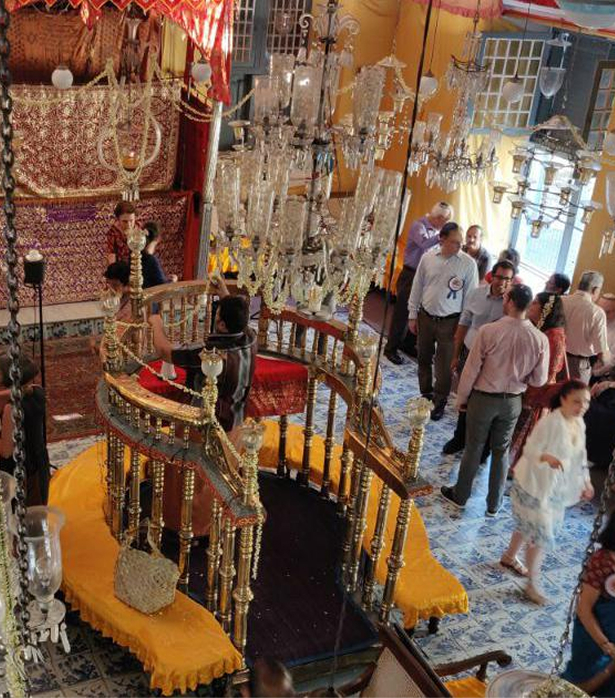

The Paradesi Synagogue's most recent milestone was its grand 450th anniversary celebration in December 2018. For a glorious two weeks, the charming streets of Jew Town burst to life as over 150 community members congregated in Kochi, hailing from Israel, the United States, Canada, Australia, and England. This remarkable gathering fulfilled the dreams of three generations, providing them with the opportunity to witness and immerse themselves in the living history they had only heard about and read about.
The synagogue's hallowed halls reverberated with the harmonious blend of prayers, songs, and laughter, as the 'palli' overflowed with members from far and wide, breathing life into the ancient walls once again.
The Paradesi Jewish Synagogue in Jew Town, Kochi stands as a breathtaking testament to the harmonious union of Jewish and Indian design traditions. From the intricately detailed woodwork, ornate chandeliers, and handpainted tiles, the structure is a visual wonder that showcases the enduring impact of cultural influences spanning centuries.
With its timeless presence, the synagogue serves as a bridge between the past and the present, a living testament to the resilience of the Jewish community. Its profound architectural and historical significance offers a mesmerizing window into a bygone era, an experience not to be missed.